
2015 Edition
The largest edition in terms of number of shows, performances and spectators
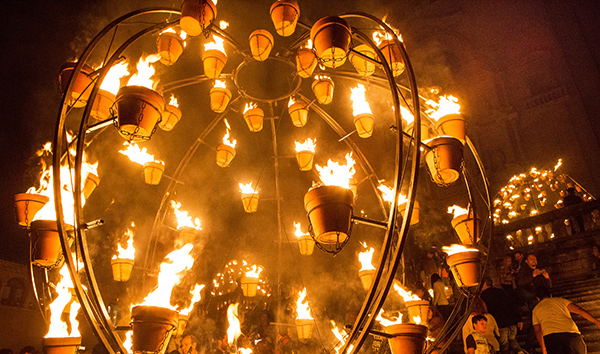
Of all the Festival’s editions, the twenty-fourth will be remembered for closing with record figures for shows, performances and audiences. We consider it the best edition to date, both for the interest and quality of some of the international proposals and for the strong crop of productions, as well as for Temporada Alta’s commitment and involvement with Girona society. It is also the edition of the connection between the programme and the public, with shows such as La cerimònia del foc by the company Carabosse, Roger Bernat’s Please Continue (Hamlet) and Hofesh Shechter’s Made in Girona: Political Mother.
Shows: 108 (including cinema)
Co-productions: 22
Premieres: 42 (+ 4 cinema)
Audience members: 78,922 (total) / 91.80% (occupancy)
Venues: 22 (+ cinema + street)
Budget: 3,128,318.51 €
Documents

Poster 2015, Carlos Pazos
A “pop-ular and slightly pop” image
“I don’t like posters that are an artist’s work trampled on and pierced through by text at all”, says Carlos Pazos, the creator of the poster for this edition of Temporada Alta: “I have a special interest in design and graphic design. In fact, when I was young I worked in graphic design to earn some money. I find it much more interesting when the collaboration and the work of the designers become part of the piece and are integrated much more, and much better, into the work”. For this reason, Pazos created a piece with a life of its own, from which the designers at Elpulpo Studio produced the poster. “I left it somewhat open so that the intervention could take place in a more natural and healthier way for both the artist and the designer”.
“I created the whole image and part of the text, and suggested to the design team that they do the rest however they wished, and we did not have to correct anything; they understood the commission wonderfully and I think they were excited by it. I am very satisfied with the final result: it is still a work by Carlos Pazos and, at the same time, the poster is much more interesting”, explains the artist. The team chose part of the typography, and the artist had left them space to incorporate the festival’s brand. But the collaboration between them was not limited to the designers following the artist’s instructions to the letter. “They also included an enlargement of an image I had pasted, because, as I almost always do, I made a collage, and they overlaid the image I had put there. The collaboration was stimulating for them and, for me, the result was magnificent”. As for the typography, the artist used the box of a well-known champagne brand for some of the letters in the word “Temporada”, while the polka-dot strip on the left comes from a luxury underwear brand: “I wanted the image to be pop-ular and a little bit pop”.
The central theme of the poster for this edition of the festival is the mask, introduced through the two images in which a man holds three loaves of bread in front of his chest and genitals. The images were made by Pazos himself and come from his archive. “I did not make them expressly for the poster. I have an archive of images, made by me or cut out, of ideas, and when I receive a commission I start going through it. I found it quite suggestive to turn those loaves into a mask. They are one, but in another way”.
The enlarged image Pazos refers to is that of Thumper, the rabbit from Disney’s classic Bambi. “I work a lot with memories and images from my childhood. He is a character who always attracted attention. When I was a child, there was a programme on Radio Barcelona called ‘Tambor’. Tambor always struck the ground with his left paw as a call for attention. I have used him as a memory of this character who draws attention to the fact that something important is happening, so that people notice”. “I am a great lover of animals and not much of a lover of human beings, and that is why I like, as I have done in this case, to ridicule human beings. Many playwrights have done this and have exalted animals. I remain a great admirer of Walt Disney, and he always played a great deal with the humanisation of animals. Animals can also represent a Shakespearean reference, but in general I use them because I like them very much; I think they are wonderful beings”.
Even so, “I am not a great lover of theatre, but that does not mean I do not go to the theatre”, Carlos Pazos concludes. “I am fanatical about cinema and music, but I do not have a great theatrical culture”. However, as the artist lives in Paris for much of the year, “I usually see productions of works by Thomas Bernhard; they stage many of them, although I am more interested in the author than in the show”.
At this point, it is obvious to say that the Temporada Alta posters are the work of the most outstanding Catalan artists of recent decades, such as Antoni Tàpies, Antoni Miralda, Jaume Plensa, Eulàlia Valldosera, Perejaume, Frederic Amat and Eugènia Balcells. “Carlos Pazos, a deserter from architecture studies, the well-off son of a family steeped in the diffuse Francoist and noucentista climate that characterised much of the local post-war bourgeoisie, made his first timid appearance in the early 1970s, in the context of conceptual practices”, says art historian and critic Martí Peran. “Even so, his empathy with the group was little more than strictly generational. Carlos Pazos was only a conceptual artist insofar as the term is used to refer to the more or less radical proposals that spearheaded the renewal of Catalan art between the mid-1960s and the late 1970s”. “The heading of conceptual art, in fact, is very eclectic in the local context —the text continues—. Within it, as we suggested, there is room for various poor, ephemeral or object-based poetics that, in different ways, opposed the conventions of abstract modernism and realism, still dominant then throughout Spain. Hence even practices close to a pop language could, to a certain extent, also be considered within the generous epithet of conceptual art. This is in fact the ambiguous zone in which Carlos Pazos is usually placed, in the strange hybridisation between conceptual and pop that, it seems, serves as a catch-all to locate certainly “slippery” artists of the 1970s (alongside Pazos, also the work of the then Albert Porta, Jordi Galí, a little of Silvia Gubern, and even another artist as elusive as Àngel Jové).
Carlos Pazos’ connection with pop art is evident, but it needs to be specified in many respects. The artist himself states that his first sources were “pop and povera”, and there are certainly many parallels between his works and, for example, the Bunk series that Eduardo Paolozzi reissued in 1972. However, Carlos Pazos’ works when he first became known in 1971 (Anell, Abrillantador, Les enfants terribles…) are much closer to the surrealist object —in the way Meret Oppenheim understood it— than to purist North American pop art or to the interests —alongside objects with great evocative potential, an interest in technology and machinism— that shaped Richard Hamilton’s British Independent Group. The pop that interests Carlos Pazos is, in fact, the “dirtiest” kind, derived from Duchamp and neo-Dadaism and pointing towards Warhol, Rauschenberg and French nouveau réalisme”.
Antoni Ribas
Carlos Pazos
Carlos Pazos (Chronology taken from the catalogue of the exhibition the artist has on show until the end of July at the Centre d’Art Contemporani Piramidón: Bisturí o arsénico. Carlos Pazos in the Piramidón collection, Centre d’Art Contemporani). Do not miss it.
He held his first solo exhibition in 1970 and his first retrospective, «No me digas nada», in 2007, at MACBA (Museu d’Art Contemporani de Barcelona) and MNCARS (Museo Nacional Centro de Arte Reina Sofía). He received the Comunidad de Madrid Prize in 2003, the National Prize for Visual Arts in 2004 and the National Prize for Visual Arts of Catalonia in 2008. He is an undisciplined artist, which allows him to turn to the most suitable media for what he wants to do at any given moment: collage, sculpture, film, photography, installation or performance. A lifelong lover of music and the night, he ran the Salón de Baile Cibeles (1978-1982), with a capacity of 800 people and two live salsa and swing music orchestras; the cocktail bar Bijou (1983-1986) and the music bar Je-rrix (1994-95). In this venue he established the headquarters of his Fan Club, whose activities were relaunched in 2014 with the CP Selection project following his participation in the Over 60 revolutions programme at the Academia de España en Roma. A lifelong lover of books and letters, in 2004 the Universitat de Barcelona published his first book of texts, Garabatos y Zarpazos, reissued in 2007. His second book, Pimpollos y Papanatas, was published by Comanegra in February 2013. A lifelong lover of cinema, in the 1960s and 1970s he made several Super 8 films, little of which remains. In 1987 he starred in Jordi Cadena’s film Es quan dormo que hi veig clar, based on texts by the poet J.V. Foix, and in 2006 he wrote and directed Mnemocine. Película recortable, a 26-minute film made up of 11 audiovisual fragments. Returning to his passion for music and taking advantage of an invitation to exhibit at the Centro para el Desarrollo de las Artes Visuales in Havana, he shot the film Yo inventé unos Llopis, which was presented at La Casa Encendida in Madrid in June 2012, at Cinema Ciutat in Palma de Mallorca in September of the same year, at the Filmoteca de Catalunya in February 2013 and at the Real Academia de España in Rome in March 2014. In September 2014, he presented the first phase of the project For CP Fans Only Portátil, physically located in the facilities of the Zedis factory in Lliçà d’Amunt. It consists of 13 transportable booths housing a substantial part of Carlos Pazos’ works, organised thematically and/or chronologically depending on the case, with the aim of enabling his work to travel easily from one side of the planet to the other. Currently, continuing his passion for art and literature, he is preparing a feature film entitled Artíssimo, collage para leer, which he will present? in September this year at the Museo Nacional Centro de Arte Reina Sofía, Madrid.

Short 2015, Tragèdia, el cant de la cabra
The 2015 festival short film, winner of the Laus d’Or Award.
The short film presenting the 24th edition of Temporada Alta tells, with sensitivity and a distinctly poetic tone, how theatre was born more than 2,500 years ago, through a story set in present-day Greece. Now that Greece and culture are going through such a difficult time, we want to champion Greece and we want to champion culture.
An old man explains, with a certain nostalgia, the origins of Greek tragedy and the origins of our culture. Through a mythical and timeless account that brings about silence, the short film reflects on the tragic distance between Ancient Greece, the mother of all European cultures, and present-day Greece, punished by Europe and seemingly forgotten by the main lines of its cultural genesis. But this man reminds us, with difficulty, of where we are from and where we come from, showing that there is still room for hope in a future rebirth. To be born again, one must acknowledge the darkness; one must be willing to die —a visual metaphor for life and death that recurs throughout the story.
The short film seeks to present Temporada Alta as a protective bastion of the values and human attitude that have guided us along the path of knowledge since the beginnings of theatre. It is our Tragedy, the root of everything.
The documentary, which was filmed entirely with 20 local residents between 1 and 7 August in Greece and Albania, is aimed at all kinds of audiences and, although the original language is Greek, the short film will be subtitled in Catalan, Spanish and English.
Artistic credits
Production: Nanouk Films
Direction: SS (Salvador Sunyer and Sergi Cameron)
Production design: Víctor Santacana
Director of photography: Miquel Martínez Miró
Original soundtrack: Diego Pedragosa and Sergi Cameron
Sound design: Marc Bech (Coser y Cantar)
AWARDS
Laus d’Or in the audiovisual category
Public survey
In order to improve the festival and prepare for the 25th edition, Bitò Produccions carried out a survey among Temporada Alta spectators. The survey was conducted by email and answered by a total of 1,238 spectators. The survey shows that the audience is, once again, the great accomplice of the Temporada Alta Festival. 99.6% of the spectators surveyed say they will return to the festival and 99.52% say they would recommend it. The festival’s warm reception benefits the region, helping to project the city’s cultural image.
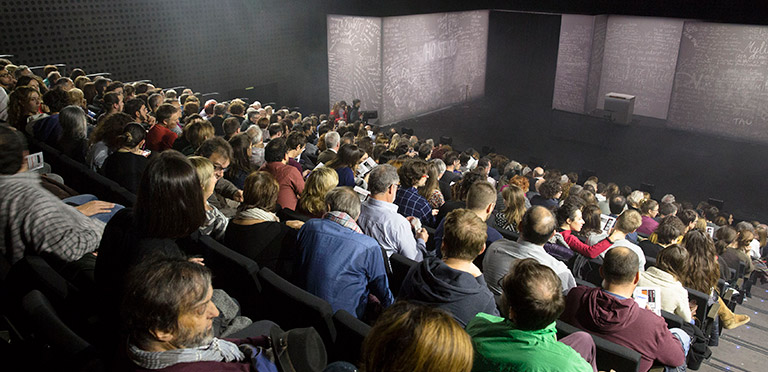
55% of the spectators surveyed live outside Girona or Salt and take advantage of the day they come to see a Temporada Alta show to do other activities in the city. As an asset of the region itself, the festival is a tool for promoting the area and developing cultural tourism in Salt, Girona and Catalonia.
