
2016 Edition
Temporada Alta celebrates 25 years
The most noteworthy aspects of this twenty-fifth edition are: the Festival’s role in the internationalisation of the Catalan scene, its rootedness in the various structures and spaces of our cities (schools, social organisations, secondary schools, associations…), the presence of a more diverse and heterogeneous audience, the quality of the shows premiered and Temporada Alta’s boost to the Catalan scene. Some of the leading artists in this edition include Krystian Lupa, Thomas Ostermeier, Peter Brook, Guy Cassiers, Milo Rau, Nicolas Stemann, Rocío Molina, Mauricio Kartun, Xavier Bobés, Jomi Oligor, Shaday Larios, Lluís Pasqual and Àlex Rigola.
Shows: 99 (+ cinema)
Co-productions: 28
Premieres: 33
Audience members: 47,731 (total) / 96.31% (occupancy)
Venues: 28 stages
Budget: 3,220,726.41 €
Dossiers
Poster 2016
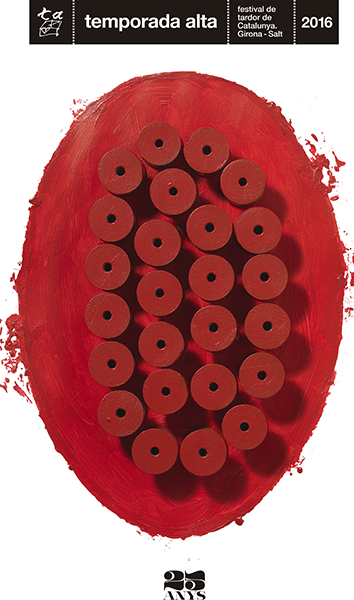
Pep Duran celebrates 25 years of Temporada Alta by filling the sky with signs charged with poetry.
As well as bringing together some of the most outstanding contemporary Catalan artists, the posters from the different editions of the Temporada Alta festival reveal another curious fact: many of the artists who have created one of the posters are connected, in one way or another, with the world of theatre. Narcís Comadira, as well as being a painter and poet, is also a playwright. Frederic Amat has developed a prolific career as a set designer. In Carles Santos’ work, music, theatre and the visual arts are often inseparable. And Jaume Plensa collaborated with La Fura dels Baus on some of the company’s first operas. There are also other artists who have not entered the theatrical world directly, but whose work can nevertheless be said to draw on the ritual and festive roots that lie at the origins of theatre. This is the case of Antoni Miralda, known for his large-scale performances, and also of Eulàlia Valldosera: this artist’s installations evoke intimate rituals and sometimes include elements as fragile as the ephemeral nature of a theatrical work.
The Temporada Alta festival turns 25. Consciously or unconsciously, Salvador Sunyer has commissioned the poster for this edition from an artist, Pep Duran (Vilanova i la Geltrú, 1955), who, together with Frederic Amat, has the most firmly established relationship with the world of theatre among the list of artists with whom the festival has collaborated. As well as being an artist, Pep Duran is a set designer. He teaches at the Institut del Teatre and is currently working on the set design for the production of Lars Noren’s El coratge de matar, which director Magda Puyo will premiere at the TNC in October. Duran’s poster follows in the line of the impact caused by the posters by Àngel Jové and Antoni Miralda. The split melon on Miralda’s poster prompted many explicit comments. Pep Duran’s —a red oval shape, full of holes, or of protuberances with a hole at the end— could do so too. But that is not what it is. Looking more closely, one can see that Pep Duran’s poster is, in fact, the photograph of a piece in relief. The protuberances are spools of thread. With them, the artist sought to evoke, as he explains, “Ariadne’s thread, the thread of the Festival’s 25 years”. The spools may also be “25 eyes”, as if the poster were a portrait of Argus, the mythological giant whose head is surrounded by eyes and who never sleeps. “They are a sign in the sky”, the artist concludes, thinking of how his work will look on the banners. On the other hand, the spools may evoke the textile past of the Coma-Cros, where the headquarters of El Canal is located, although the authorities do not seem willing to get down to work and set the centre fully in motion.
For Pep Duran, the poster is not an unfamiliar medium. He has made them since the 1970s, and has even made them for his own exhibitions. The spools he has used for the poster of this edition of the Temporada Alta festival refer to the humble materials that characterise his work. He uses them because they connect him with arte povera and, above all, as he himself says, “with Antoni Tàpies, Joan Miró and Joan Brossa”. In recent years, Macba has exhibited two pieces that highlight Duran’s inventiveness with materials: a monumental ceramic Retaule laic, shown at La Capella in 2011, and, last year, as part of the exhibition Espècies d’espais, an installation consisting of the recycling of a series of previous works.
Antoni Ribas
Pep Duran
Pep Duran (Chronology taken from the online magazine masdearte.com and the Macba website).
Vilanova i la Geltrú (Barcelona), 1955. Catalan sculptor, painter and set designer.
He trained artistically at the Escola de Formació Artística de Vilanova i la Geltrú and later at the Institut del Teatre in Barcelona, where he currently works as a teacher. He has lived in the city of Barcelona since 1970. In the 1970s, his main activity was the construction and design of sets and costumes, working at the Teatre Lliure and with the theatre company El Tricicle, among others. As for his visual work, painting and sculpture, it is dominated by the integration and accumulation of objects that produce surprising effects and create a surrealist atmosphere. In the 1980s, he took part in the artistic movement associated with postal art that emerged in North America, as shown by his participation in international exhibitions under this heading in Japan, Rome, Amsterdam and Cologne. His most recent creations move away from this variegated world and tend towards order and geometrisation, beginning to relate to constructivism and, more specifically, to the work of Tatlin. He has held major solo exhibitions and has taken part in numerous group shows, including: Muestra de Arte Joven at the Círculo de Bellas Artes in Madrid (1985), Confrontaciones at the Museo de Arte Contemporáneo in Madrid (1988) and Constants de l’art català at the Centre d’Arts Santa Mònica in Barcelona (1992).
The artist’s latest creations are the exhibition entitled Una cadena d’esdeveniments, presented in 2011, and the most recent is part of the group exhibition Espècies d’espais, which was on view until April 2016. Both exhibitions were presented at the Museu d’Art Contemporani de Barcelona (Macba).

Short 2016, The pleasure island
The pleasure island is the audiovisual piece created to present this year’s Festival, a hybrid between an advert, a short film, a music video and a meme. Once again, Temporada Alta and Nanouk films have joined forces to present this proposal as the Festival’s starting signal.
Year after year, the location where the advert is filmed has played a crucial role: if in 2015 the chosen location was Greece, in 2016 it was the Manhattan of the Spanish Coast: Benidorm. The filming system for this piece was very similar: a very small team, extensive fieldwork and strong interaction with reality. The ultimate aim was to create an auteur piece with a high artistic content.
While last year the aim was to reflect on Europe, this year the focus has been placed on our own country, whether Catalonia or Spain, with the purpose of ensuring that the Festival’s established audience, artists and other cultural agents involved feel represented and can help create a distinctive, collective identity through audiovisual media, a highly universal medium.
The director of this piece was inspired by Pleasure Island or Toyland, the place where Pinocchio, Carlo Collodi’s famous character, ended up in search of eternal fun. A metaphor that has served him to shape a critical piece aimed at all those who reduce culture to mere entertainment.
The director has said…
Pleasure Island or Toyland was the place where Pinocchio, Carlo Collodi’s famous character, ended up in search of endless fun. The infinite roller coasters, drink and games amazed all the children who had run away from home to escape their school duties. Little by little, and without being able to do anything about it, they turned into donkeys, until in the end they were used as slaves whose only purpose was to carry stones day and night.
Unlike other countries with a stronger tradition, here at home —especially after the crisis— it feels as though culture has little more purpose or justification than to be entertainment. Just another sector of the leisure industry, there to help people switch off and have a good time. It feels as though creation, research or culture that requires a certain effort is either looked down on or considered a waste.
That is why, in order to explain Temporada Alta, this year we wanted the advert to have a strong critical vision that might prompt some reflection on what we consider a major danger: incorporating these ideas into the collective imagination while forgetting that, if art and culture have anything, it is that they empower people and give us the tools we need to build what we are and what we will become.
If culture in this country is only meant to serve as a distraction and a way of having a good time for a while, and nothing more, then the Temporada Alta festival has failed and has spent 25 years doing useless things.
Artistic credits
Director: Salvador Sunyer i Vidal
Script: Salvador Sunyer and Victor Santacana
Production Designer: Victor Santacana
DOP: Oriol Barcelona
Focus Puller: Alicia Galiña
Line Producer: Andrés Mellinas
Production Assistant: Anna Meléndez
Account Manager: Sandra Olalde
Copy review and Translator: Francisca Torres
Editor: Sergi Cameron
Assistant Editor: Anna Meléndez
Sound Editor: Diego Pedragosa – Iristudis
Sound Mix: Marc Bech – Coser y Cantar
Sound Mix: Marc Bech – Coser y Cantar
Voice Actress: Julie Nash
Graphic Design: Tomeu Mulet
VFX Supervisor: Bernat Fontanals
Colour Correction: Lluís Velamazán
DCP: Raúl Busquets
Nanouk Films assistant: Airam Rodríguez
Nanouk Films Central Commission: Sergi Cameron, Ventura Durall, Salvador Sunyer
Special thanks: Café Román, Exodo Rental, Acariciando el Aire, Terra Mítica, Mundomar, Aqualandia, Michele Catena, Benidorm Palace, Bitò Produccions and PlayGround
Music: La Leyenda del Beso – Intermedio
Composed by: Reveriano Soutullo and Juan Vert
Performed by: Orquesta Lírica de Madrid
Produced by: Nanouk Films – 2016
AWARDS
Grand Laus (the highest accolade at the Premis Laus)
German Design Award
Public survey
Preferred times for going to the theatre, the audience’s engagement and loyalty, and confirmation that the Festival is a tool for boosting tourism and the economy in the region are the main conclusions of the survey carried out by Temporada Alta 2016 among 1,861 spectators registered in its database.
The main aim of this questionnaire was to gather their opinions in order to improve Temporada Alta’s relationship with its audience and assess the economic impact of Temporada Alta on the region.
The Festival’s warm reception (45,000 spectators) benefits the region, especially tourism, commerce and hospitality.
Among the most noteworthy data are those confirming that Temporada Alta is an important tool for developing cultural tourism in Girona and its metropolitan area.
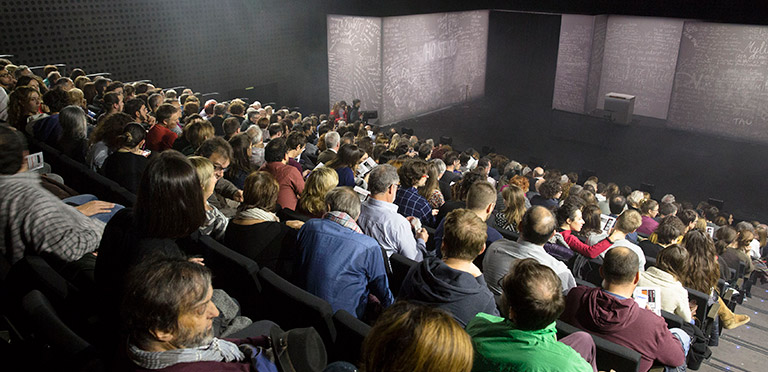
Only 4% of respondents who live outside Girona and Salt and come to the Festival do so solely to see theatre. The rest (96%) complement their visit with another activity that has an impact on the local economy: 26% have at least one meal in a restaurant, 18% visit the old town, 11% go shopping and 8% go out at night. Visiting a museum or monument and going to the market are also activities that complement the shows. In addition, among respondents who come from outside Girona and Salt, 3 out of 10 stay in a hotel.
A loyal audience
The survey also confirms the audience’s engagement with the Festival and with culture. 99% say they will return to the Festival and 100% say they would recommend it (only 8 of the 1,861 people who answered the survey responded “no”). The Festival’s most highly valued attributes are the quality and variety of the shows, as well as its international and contemporary programme, which have become one of Temporada Alta’s defining features. On the other hand, the main complaints from some spectators are high prices and how quickly tickets sell out. Better compatibility with public transport and restaurant opening hours is another requested improvement. Even so, it is worth stressing that 28% of spectators would not change anything and that 98% take away a good memory of the Festival.
This survey, carried out by Temporada Alta, was conducted by email on 5 December among spectators registered in the Festival’s database who had purchased at least one ticket for the 2016 edition.
