
2017 Edition
Temporada Alta makes a strong social and educational commitment
This edition sees the launch of a new programme: A Tempo, Arts i Formació. We are promoting it with the aim of bringing culture into school classrooms. A total of 3,690 students, 182 teachers, 28 schools and 70 professional artists have taken part in this project. At the same time, we continue to uphold our social commitment, with 2,818 tickets allocated to social groups. Some of the leading artists in this edition include Alain Platel, Àlex Rigola, Romeo Castellucci, Josse De Pauw, Pep Tosar, Guy Cassiers, Elfriede Jelinek, Buika, Roger Bernat, Lali Ayguadé, Christiane Jatahy, Rocío Molina, Sílvia Pérez Cruz, Quim Giron, Oskaras Korsunovas, Mariano Pensotti, Abbas Fahdel, Carlos Marqués-Marcet and Íngrid Guardiola.
Shows: 108 (including cinema)
Co-productions: 26
Premieres: 49
Audience members: 52,753 (total) / 90.57% (occupancy)
Venues: 22 stages
Budget: 3,189,113.16 €
Dossiers
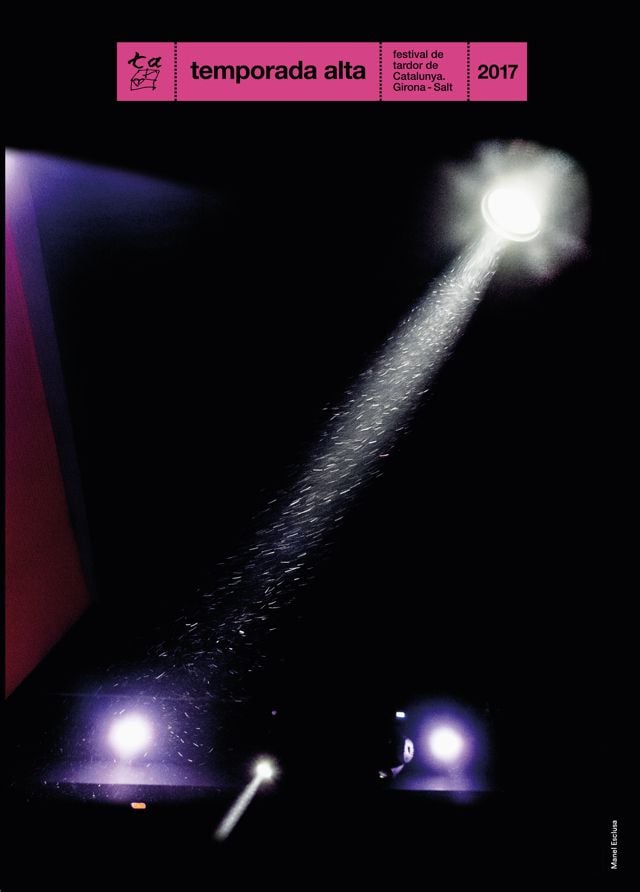
Poster: Carmen Calvo
The great voyeur of theatre
Carmen Calvo received the commission for the poster of this edition of the Temporada Alta festival with enthusiasm: “the travelling companions are wonderful”, says Carmen Calvo of the other artists who have preceded her, among whom she highlights “the great master” Antoni Tàpies.
“References are what allow us artists to keep going”, she stresses. References once again become important when we begin to talk about the figure on this year’s poster: the blindfolded female figure recalls the sculptures Joan Miró made by bringing together different everyday objects. Carmen Calvo’s woman is made up of a mannequin head and a stool. As one of the stool’s legs is broken, the artist levelled it with a box and two additional pieces of wood.
“The image is only points of light and the trace of light”, says Manel Esclusa. “I thought it was connected to the world of theatre,” he adds, “for there to be two important elements within the set design: lighting as it was originally, with candles at floor level, and later overhead lighting, with electric light. Both illuminate a stage where there is still no protagonist of the show”.
It is difficult to explain so much with so few elements. The protagonist of the image is a beam of light, but the spotlight that projects it creates a space where it is not yet known what will happen. And this unknown is both exciting and dizzying. “It is about the mystery that darkness brings, which exists because there are lights that reveal it, just as light exists because there is darkness”, the artist explains.
“Lighting defines a space and is a protagonist, because it gives the scene a specific character”, stresses Esclusa, who also explains that the lights on the poster for Temporada Alta can evoke “the beginning, the interval or the end of a show”.
Although Manel Esclusa’s image for Temporada Alta was made inside a theatre, it connects very directly with his nocturnal photographs of urban spaces. “Photography is also a constant balance between light and darkness”, the artist concludes.
Manel Esclusa’s image can also be seen as a counterpoint to the one Francesc Torres created for the Festival in 2012, in which he transformed the movement of an acrobat almost into a trail of light. The festival maintains an ongoing collaboration with the world of photography. In addition to Manel Esclusa and Francesc Torres, it has commissioned works from other photographers such as Toni Catany, Joan Fontcuberta and Josep Maria Oliveras.
Antoni Ribas
Manel Esclusa
Born in Vic in 1952, Manel Esclusa is considered one of the most outstanding Catalan photographers of recent decades. He came to photography as a child through his father’s laboratory, working with him in the field of commercial photography between 1966 and 1972. In 1974 he was awarded a Photography Grant from the Dotació d’Art Castellbach and attended the Stages Internationaux de la Photographie in Arles, France, where he was taught by photographers of the calibre of Ansel Adams, Neal White, Arthur Trees, Ian Dieusaide, Denis Briat and Lucien Clergue. Shortly afterwards, he became one of the founders of Grup Alabern alongside Rafael Navarro, Joan Fontcuberta and Pere Formiguera.
In the late 1970s, Esclusa began his research into the conditions of nocturnal light and various aspects of low light, a theme he has maintained to this day. The results of these processes of technical experimentation have succeeded in materialising light, creating architectural spaces through shadows and lighting effects that construct ghostly, dreamlike and poetic spaces.
He is an internationally recognised artist, thanks to numerous exhibitions such as Aquariana, Gits, Ahucs and Naus, among others, most of them with international resonance. His works can currently be found in the Bibliotèque National, the Museu Réattu (France) and the Museu Nacional d’Art de Catalunya, as well as in many other museums and private collections. Alongside his career as an artist, Manel Esclusa has worked as a teacher throughout his life, both in workshops and in schools.

Short 2017, L’incendi
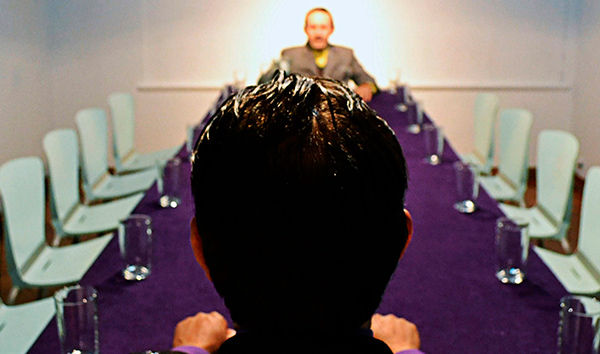
A match is nothing unless it starts a fire. L’incendi is the audiovisual piece created to present Temporada Alta 2017 and was awarded the Premi Gran Laus, the highest accolade at the Premis Laus for Graphic Design and Audiovisual Communication (2018). Once again, the Festival joins forces with Nanouk films to present this work which, in recent editions, has already earned recognition from the sector, critics and audiences with the Premi Gran Laus (The Pleasure Island, TA 2016) and the Premi Laus d’Or (El cant de la cabra, TA 2015). This year’s proposal, filmed at the Teatre Municipal de Girona, aims to be a song to freedom, asserting theatre as a space free from constraints. It seeks to turn the rules of advertising upside down in order to present an “anti-advert” that is “free” enough to question itself, the world of culture and its audience, which is, ultimately, the heart of the Festival.
The director of the piece, Salvador Sunyer Vidal, says that, when considering what the freest kind of advertising might be, he reached the conclusion that it is advertising that criticises the product it promotes and, ultimately, its consumers. This year’s promotional short is therefore somewhat provocative: it does not seek to please everyone, but rather to generate a sense of discomfort in the audience. It is from this unease that it seeks to involve the Festival’s audience and make them reflect on the role of culture in general, and the performing arts in particular.
The director has said…
At Nanouk, we are proposing a promotional piece with its audience and with the world of culture, to remind us that every artistic expression has the obligation to look itself in the mirror and question itself. If it could not do so, it would not be art.
The protagonist of the advert has no mask to protect him and, for that reason, he is granted a certain moral authority. He fulfils the function of a tragic divinity or simply of a naked actor. To choose him, we looked for a real person who had a detached view of the performing arts and their function. Curiously, we found him right next to the Teatre de Salt. He is a young man who never leaves the house but always watches people going to the theatre from the window. Now he has entered the temple to proclaim what he thinks without mincing his words.
The theme of the promotional short is freedom and, in order to be free, the first thing we must do is be able to renounce. Be brave and break our chains, even if they are made of gold!
Fire is the main element of this piece. Fire understood as an element that liberates and purifies. Only if you burn everything you think you have, and are, will you be free. A theatre spectator must live up to the art they consume. It is this mutual relationship that raises or lowers the level of the other. This is the shared demand.
In an ideal framework, theatre is a collective space for reflection where anything should be possible. I would like to be able to convey this feeling in the piece we are making to promote it.
Artistic credits
Script: Salvador Sunyer and Victor Santacana
Actor: Aleixo Paz Perez
Voice: Lluís Soler
Produced by Nanouk Films
Director: Salvador Sunyer / 1st Assistant Director (pre): Àlex Macías / 1st Assistant Director (shoot): Bea Hernandez Moreno / 2nd Assistant Director: Marc Ferrer Domínguez / Direction Assistant: Nil Fortón Pomada
Production direction: Anna Salgado Balderas / Production manager: Núria Andrés Rodríguez / Nanouk Films production: Sandra Olalde / Bitò production: Sarah Agustí and Anna Rodrigo / Ajuntament Cultura: Rosa Carles
Director of photography: Elías M. Félix / Camera assistant: Ana Ferrón Vivas / Video Assist: Judit Saizar Ardanuy
Gaffer: Xavier González Margalef / Grip: Jose Miguel Castillo Fernandez and Jose Ramón García Martínez / Teatre Municipal technician: Txema
Art direction: Judit Ferrer Gimeno / Graphic design: Francisca Torres
Sound design: Oriol Bonals Liso / Sound mix: Martí Albert
VFX supervisor: Sergi Rejat i Martinez
Editor: Victor Navarro Diago
Colourist: Lluís Velamazan
Suppliers: Service Vision (camera), Service Vision (lighting), Service Vision (machinery), Nasa FX (effects), WRS (walkies), Coser y Cantar (sound), Ricard Hidalgo (production), Galan Rent a Car (vehicles) and CineVent (insurance).
Extras: Antonia Roger, Montserrat Tomeu Manzano, Carme Sabater, Lluïsa Camps Parella, M.ª Rosa Quintana, Martí Guillamet Jou, Carme Sedano Noguera, Mayte Casamitjà, Anna Pulido Sanchez, M.ª Lluisa Alorda Esquinas, Maria Paula Güidi Sassano, Anna Daniel Cases, Glòria Polls González, Zoraida Pico Valderrama, Rosa Martí Poch, Marycielo Giron, Solymar Jaimes, Carme Pintó Curras, Elena Noguer Rubiola, Núria Masaló, Pere Figueras, Francesc Garcia Sagrera, Carme Gros Córdoba, Joan Cervera Morell, Magda Ruiz Exposito, Matilde Campmajo Sansanedas, Adela Cuenca Martínez, Raul Gonzalez Bautija, Ricard Camó Campillo, Joan Luis Prado Bastante, Marina Angelica Saldaña Santivañez, Montse Cordero Rodriguez, Montse Alabert Rius, Amelia González, Maria Gracia Salas Torreblanca, Maria Rosa Sánchez, Antonia Vilaplana Moreno, M.ª Lluisa Riera Ros, Conxi Beser, Núria Ripoll Solé, Carles Borrell, Lluís Torner i Calillo, Magdalena Fiam, Francisca Piló Borrega, Carles Duran Batlle, Miracle Sala Farré and M.ª Dolors Rodí.
AWARDS
Laus d’Or in the audiovisual category
Grand Laus (the highest accolade at the Premis Laus)
Audience survey
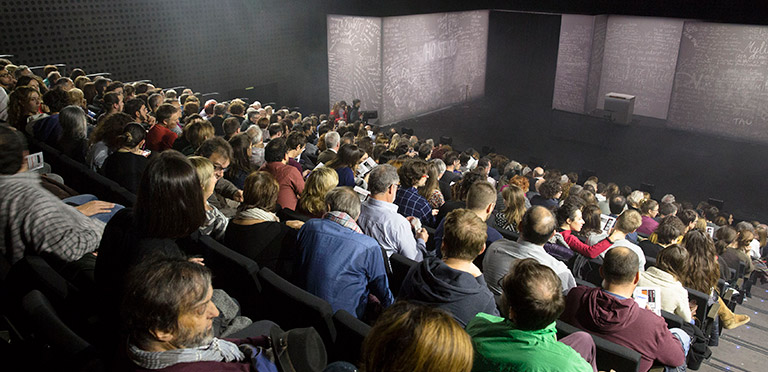
The pricing policy and purchasing habits, the audience’s engagement and loyalty, and confirmation that the Festival is a tool for boosting tourism, the economy and culture in the region are the main conclusions of the survey carried out by Temporada Alta 2017 among 1,700 spectators registered in its database.
The questionnaire was sent out on 6 December 2017 with the aim of introducing improvements in future editions of the Festival and establishing new forms of relationship with the audience.
Main areas of the survey:
- 99.7% of those who responded to the survey will return for the next edition, and 99.8% say they would recommend Temporada Alta to their friends.
- Only 12.5% of respondents are against flexible pricing.
- 7 out of 10 spectators who live outside the Girona urban area eat at a nearby restaurant before or after attending a show.
- 75% of the spectators who responded to the questionnaire make use of one of the discounts available to them.
- Temporada Alta is associated with words such as: “Magic”, “Joy”, “Necessary”, “Close” and “Enriching”, among others.
